In my last post, A Journey of Grief, I wrote about my experiences working through the grieving process regarding my son’s autism. As I reflected on the feedback I received after this and a few other of my posts, I thought it might be helpful for others to understand my thoughts and approach to writing. A few of my earlier posts had been written within a day’s time but now, most of my pieces are pondered for days in advance and then written over a series of days. Sharing a new post only on certain days of the week, helps ensure that a post is carefully thought through and written before seen by others. It is a considerable commitment and use of time and brain energy. In some of the pieces I write, there may a certain vulnerability that seems to make some friends a bit uneasy, but because I know what lies behind my writing and what I don’t share, I believe that my vague bit of vulnerability is helpful and wise. Interestingly enough, I have a seemingly growing group of readers and folks who visit the blog yet, this blog would never be considered a success.
So why do I do this? Why do I share the things I do?
Why do I write?
When I was in 9th or 10th grade, our English teacher gave us an assignment during class to write about a memory of some special moment in our lives. I remember writing about a simple memory, a sweet moment in time that I found endearing. As she walked around the classroom, she peered over my shoulder, read what I wrote, and then in her most sarcastic voice said, “Well, you’re a very boring person, aren’t you?”
Suddenly, the piece I had written, which seemed so sweet and innocent just moments before, became odious to me. I felt ashamed as I listened to her praise the writings of the other students, not because their writing was superior to mine … but because she found their memories … their stories … more interesting than mine.
In that moment, my writing changed … I changed. I no longer wrote anything that was real in my life. I only wrote the words I thought someone wanted me to write. Words that would be acceptable and even pleasing to others. Words that would bring praise instead of ridicule.
For that assignment, I chose to write a different piece instead. A completely made up story that never happened to me, but was filled with enough drama and pretense to excite the reader. That piece caught her attention.
It wasn’t true but it was engaging.
When I went to college, I took a writing class with a wonderful professor. She was encouraging and kind as she challenged us in our writing and verbal presentations to the class. With each word of encouragement, I found that I grew to enjoy the process of writing but, even so, very little of what I wrote was true.
Writing simply became a way to alter the perceptions I thought others had of me.
On a side note, I’ve been working on another blog post about pretense ~ I guess this will be its introduction.
After college, I didn’t write again for years. The next time I picked up a pen was after my son was born. I began to pour out my prayers and thoughts to the Lord in journal form. Inspired by a Christmas program being held at my church, I wrote and performed a one person drama written from the perspective of Mary, the mother of Christ. I considered the depth of love I had for my own son as I wrote about Christ’s birth, life, death, and resurrection … all from the eyes of a mother.
It is still scribbled on notebook paper but it remains my most favorite piece of writing.
Eventually, I had access to the internet and was introduced to social media. I began to share little stories from life on Facebook and eventually people would encourage me to write more … whether in blog or book form.
I opted for the blog.
My first attempts were mostly the outpouring of words held inside too long. Stories left too long unspoken. Yet, while those attempts may have engaged the reader and triggered the emotions, they were written in the style of the past. The stories were real but the way I wrote them didn’t reflect me … it reflected the past.
So that blog was left by the wayside … I don’t even remember what it was called.
Then, one year ago, it seemed like it was time.
It might be helpful for the reader to understand that my life tends to be one of significant loneliness and isolation. I am not free to be around people and involved in community life as I would dearly love to be. I have spent years trying, searching, and praying for relationship, friendship, and belonging, but to little avail. In this past year, the only answer I have received to my prayers has been that it was time.
Time to begin investing in writing, intentionally and thoughtfully …
As an outlet for me, sure. But more so for the glory of God and the potential good to others.
The first few pieces, I still struggled with the need to write in a way that I thought would be pleasing to people. But as God continues to work in the quiet places of my life, my writing is evolving into a more accurate representation of the way I think and live.
Not necessarily attractive or engaging to the masses but that is no longer my goal.
If you have made it this far, let me share the real reason I write the way I do.
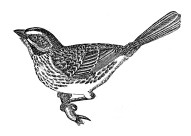
A number of years ago, I wrote a short story. It was an allegory generically entitled, The Little Brown Bird and, surprisingly enough, the main character was in fact, a little brown bird. She was a nondescript kind of bird, nothing special or eye-catching about her. The story was set in a beautiful garden that had been designed and cared for by the Master Gardener and it followed her journey as she spent her days on the sidelines of life, comparing and desperately trying to be more like the other birds in the garden who were more beautiful, and those who flew higher and more majestically, and those who sang more beautiful songs.
The little bird could never understand why she was so plain and different from the others and she grew increasingly discouraged when all her attempts to be more like them ended in dismal failure and even injury. After the final attempt, which resulted in a broken wing, the Master Gardener captured the tiny bird and carried her to the cottage nestled where the edge of the garden met the deep forest that lay beyond. There, for her own safety, he placed her inside a cage on the cottage porch. He tenderly cared for her wounds but, in her fear, she fought against him and the bars of her cage, desperately trying to escape.
As the story progressed, the pitiful little bird ended up in a tiny cage, in a darkened corner of the cottage, with a blanket carefully placed over top. She was completely encased in darkness and consumed with a terror which was paralyzing.
In that place of darkness, her true healing began.
Interestingly enough, sitting in the restricted darkness of that enshrouded cage, the little bird began to listen, truly listen, for the first time. She could not see anything and she was not free to pursue her own plans or desires, so she began to listen intently to the Gardener as He moved about the cottage. His words were unlike anything she had ever heard before and she found her fear began to ease as his words found their way through the darkness and into her place of isolation. Often, as he worked, she would hear him softly whistle a lovely tune that awoke something inside of her that she had never felt before. It stirred both an ache and a desire.
The story continued with an ongoing dialogue between the little bird and the Gardener as she learned that the melody that he had been whistling, was actually the song she had been created to sing. A song that could only be learned in captivity. A song so achingly lovely, that it could only be learned through difficulty. A song that she could only learn when she was no longer free to compare and strive to be like the other birds … a song she could only learn when she was alone with the Master Gardener.
But it was a song that she had to choose to sing.
The Little Brown Bird makes her choice and if I were to write a follow up to where I left that story, I would expand on how her song and story fits into a much bigger story … a greater song.
Maybe someday.
But for now, it may help you to understand that I am that Little Brown Bird and she is me.
When I write my stories and insights now, I am singing the song that God has been gently and systematically teaching me to sing for years.
A song I am still learning.
It is a song filled with sorrow and longing. It is a song of quiet joy.
It is a song of love.
It is the song of a bird still held within a cage.
A bird still invisible to most around her, yet singing a song of eternal significance.
I write because this is the song God has given me.
And this is the voice He has given me to sing it.
The beauty of a song is not in who hears it, nor in who sings it.
The beauty is the song itself.
This is why I write.
This is The Brown Bird’s Song.
“He put a new song in my mouth, a song of praise to our God;
Many will see and fear and will trust in the Lord.”
Psalm 40:3
 The Brown Bird's Song